Read on its own
Google AI Overviews
The AI summary that now sits at the top of US Google results. We read it as its own place, kept apart from plain search rank.
The whole web is your trade area
We speak quietly and prove it with numbers.We open every place
your buyers open
What shows up, what sits empty. We write down what we found.
The places buyers open are already settled. Search boxes and maps, social and shopping, video and reviews, communities, and the answers AI hands back.
We check each one for your brand name, and we put your rivals on the same footing.
Ads come after that.
We set the baseline before we start
We ask the same question the same way, over and over. Then we check one place at a time for your brand inside the answer.
Get the map before you move
In the places buyers look for you, we read what shows up and what sits empty.
CiteAngle fills the empty places
Concept, shoot and edit, in house
Search, social and display accounts, run daily
Channel planning and day-to-day posting
Nano to a million followers · YouTubers and public figures across markets
Korea · United States · Japan · China · Thailand · Vietnam · Brazil
So search and AI answers find you first
Broadcast and group buying as one run
Media, measurement and your own data in one ledger
We read impressions, CTA and sales apart, then pick the one to lift
The same topic moving across channels at once
The video and the words that go in those places — CiteAngle makes them, then runs them through ads and real accounts.
We build the mornings that arrive when the ads are off
Two companies in the same trade. One sees the phone go quiet the day after the ads stop. The other still finds new inquiries stacked up each morning in a month it spent less. CiteAngle builds that second morning before the ads go on.
We get your name standing in search, AI answers, maps and reviews, and we hold that ground.
We find the roads your buyers already walk, then make the video and the words that fit them.
We reopen what we fixed and set the next thing to do
We open the same places again after the work. Put the first screen next to today's and you see where the name climbed in, and where it is still quiet. What we found, we write down as it is.
We write both — where the brand shows and where it does not. You need the two together to decide what the next round does.
Three countries mean three markets
The same product does not pull the same way in Korea, Japan and the United States. We build for each market on its own terms and run it the way that market runs. Set the three side by side and you can see where to move first.
One brand name
is enough to start
We start the first measurement and hand back what we found, written as it is.
Your rivals go on the same footing, shown right beside you.
For US marketing teamsSEO · AEO · GEO · AIO · LLMO
You already sense which answers name you. We turn it into a map: brand position, who's named beside you, what to fix first.
CiteAngle measures whether an AI answer names your brand, then does the work that gets it named. Every answer that names you is a shortlist place you never bought, and traffic you are not renting. The free check takes one to three of your buyer questions to six AI answer places, same business day.
This form sends a request, and our team starts the run. What comes back: up to three buyer questions, six places where AI answers show up, one machine-run pass — the format we deliver, on your own brand, at no cost. Sample questions for your trade show up in gray. Anything you type stays yours.
Start an execution program within 30 days of payment and the diagnostic fee is deducted in full.
The spend goes up every year, and no report tells you which screens that money is working on and which ones it is draining into.
If you changed agencies and the numbers came back the same, the problem is the structure, not the method.
363%
Average ROAS — revenue returned per unit of campaign cost
Average across the accounts we ran · as of 2026-09-03
112%
Average revenue growth
Average across the accounts we ran · as of 2026-09-03
0.3%
Average refund rate
Average across the accounts we ran · as of 2026-09-03
A rank tracker watches one box. People run into a brand name on maps, in marketplaces, in delivery apps, in social feeds, in video, in reviews. Those are a lot of places, and the box is one of them.
The day you lose a position, nothing pings. The rank reads the same as yesterday and the ad numbers hold. What changed is whose name a customer sees first on that screen.
So the first round holds off on the verdict. Before we call a number good or bad, we write down what we confirmed: the screens where you stand in front, and the screens where another name does.
What we report is observed change. We write down how often your name comes up in search and in AI answers, and next to it the traffic and conversions recorded in your GA4. Your product and your market set revenue together, so those two stay on separate lines.
On Google and on Bing, the top of the page now opens with an AI answer. That is AI Overviews on Google and Copilot on Bing. People bring small questions and large decisions to these tools, and the habit keeps growing. Inside that answer there are brands that appear and brands that do not. The market splits along that line.
We show it from fifteen angles, across the 20 screens where a brand name can appear. For each question we write down whether your name was in the answer, which URL was cited as the source, and how many times a competitor got called. One table. Our measurement · screens we read in the US
So the first thing we check is who is standing in front of you.
What the gap costs. If nobody reads those answers back, you lose the shortlist without ever seeing the screen that decided it, and no dashboard turns red. Every reading is sealed with its conditions and your competitors are read side by side with you in the same run, which is why a figure from us can still be checked the following year.
The second bill comes due a year later. Without a dated baseline, any improvement you make has nothing to be measured against, so a win is indistinguishable from a good week and the budget argument restarts from zero every quarter. Without that second look you risk losing a quarter to a gain that never left one engine. We read 21 engines on 20 surfaces for that reason, so a gain on a single engine is never sold to you as a trend. The same protocol covers Korean and Japanese answer surfaces, which means a US brand expanding keeps one measurement standard at the border.
Offline, nobody signs a lease without walking the block first, because the trade area decides the business. Online, almost nobody does. CiteAngle counts whether US buyers and AI can name and cite your brand across search results and AI answers, and who is named beside you. Then it turns that proof into the pages to fix first, the sources to earn, and matched remeasurement.
51%
of surveyed B2B software buyers now start research with an AI chatbot more often than with Google
G2 The Answer Economy · n=1,076 · March 2026 · G2 itself has a stake in AI-search visibility
The answer usually comes back as a shortlist, so your brand and the rivals it names are measured side by side in the same answer — same question, same run. You see who owns each buyer question, engine by engine.
Read on its own
The AI summary that now sits at the top of US Google results. We read it as its own place, kept apart from plain search rank.
Engines we name
ChatGPT, Perplexity, Claude and Gemini now answer buyer questions before a link gets clicked — each read on its own rail.
The unit we measure
Getting picked up and cited is a win of its own — the one we count question by question, engine by engine.
Each finding lands as one clear move: the question, the place it ran on, the source to earn and the page to change. We read it before and after on the same panel, each place on its own denominator — the count we divide by.
Every term above is defined on one page — what the words mean. To see how the tools line up side by side, read how to choose one.
Semrush: where AI touches the US B2B buying journey
The panel is written for the market, not lifted from a corpus. Public sets of AI chat logs lean hard toward English — 78% of turns in LMSYS-Chat-1M (arXiv 2309.11998) and 92.35% of ShareGPT chats (arXiv 2405.01470). Even then they mirror global chat use, not the buyers in any one market. So we write the en-US panel from scratch, in US buyer wording, for your line of work. Each market gets its own panel in its own language, built from how people there really ask — never a translation of another market's set.
AI answers 10
ChatGPT · Perplexity · Claude · Grok · Gemini · Google AI Mode · Google AI Overviews · Bing Copilot · DuckDuckGo Search Assist · Meta AI model answers
Search 4
Google Search · Yahoo Search · Bing Search · DuckDuckGo Search
News 2
Google News · Bing News
Video 2
YouTube · Google Short Videos
Shopping 1
Google Shopping
Social 1
X search
| the United States | 81 |
|---|---|
| Korea | 102 |
| Japan | 92 |
| Total | 275 |
These are the screens that can carry a name in the United States. Korea and Japan bring the total to 275, and all of them were picked the same way. A screen goes on this list once it holds more than one percent of web share. The search box is one of them, and so are maps, commerce, social and video.
Right now we read 68 of 275 screens. the United States 24 · Korea 26 · Japan 18, and we add more every round. Another 13 exist and are not yet in this count. No shared data tells us how many people use them, and they go in on the day that number stands.
We do not drop or pad the list to hit a number. A screen goes in when it answers in that country's language and holds more than one percent share. Search share comes from StatCounter, which counts visits that arrived at sites through search. That is a different thing from how many times someone typed into a box. We take the last twelve months and read the middle value.
We sort every screen where a person can meet a brand name into lanes: search, maps, marketplaces, social. Six of them write their own answers, so we took nine law firms and put the same question to each of those six, seven times over. All six already had a name sitting in front. Two of the nine never reached the front anywhere. The other lanes go through the same pass.
CiteAngle does not ask a question once and stop. The roster is dated 2026-08. We ask every question we planned, with none dropped. Then we record how much the answer moves across 20 screens. We ask 21 places and count 20 screens for one reason: a single Google search puts out the results page and the AI Overview separately. The multiplication uses the engine axis, not the screen axis. Full explanation in the methodology.
One CiteAngle Panorama run asks 50 questions across 21 engines, seven times each. Every round locks its settings hash with sha256, and if a re-measurement disagrees, measurement stops there. The same run puts ten competitors on one board. The basis for this spec is in the methodology.
AI search visibility report
We find the screens where your name can appear, and we fix them . Which slot on which screen carries the name is drawn in the screen layout model.
In our measurements search and AI did not return the same answer. We measure both, and we grow the places that sell without buying more ads. Ads we read as a record. We follow each one through to the conversion it produced.
Once you know who is ahead, the question is where to start.
Depth per rung
The free check runs one to three of your buyer questions across six places an AI answer shows up, and it starts the same business day you send it.
Before you choose, here is how much we do ourselves.
Each rung reuses the same engines and the same judging rules, so the numbers still line up as you climb.
The first rung is free. Send your scope and a snapshot runs one to three of your buyer questions across six places where AI answers show up. It runs as one machine-run pass, started the same business day you send it. You see the format we deliver, on your own brand, before any money moves.
A month-over-month read only counts as proof when the questions, the places, the repeat count, the judging rules and the Wilson ranges all match. A program re-read runs the wide-angle Panorama grid every month — the same questions, asked the same number of times — so each month's change compares like with like. The math behind the run count is public in why seven runs.
Answer engines keep changing, and no one can put your query panel to last month's engines. The only record of where your brand stood is the read that ran at the time. The Panorama you run today becomes the t0 each later wave is set against. And the raw data and receipts ledger transfer to you under the engagement terms, so the whole series is yours to keep.
We sell both measurement and execution. That is why each observation and each move we ship carries a receipt — work orders, before and after captures, URLs and timestamps. Each month closes by reading the change next to your own GA4, Search Console and Bing AI Performance numbers. Those are figures you can add up again in your own accounts.
Each number here is on the record — source, date, run.
226
public statements on the registry, each with its source
5
sealed runs, bound to those statements by run identifier
10
AI answer places read on every paid audit
AI answers are already deciding who gets found. We measure where your brand stands, fix the pages, and run the campaigns. An auditable baseline you can check line by line: the whole grid run, repeated passes, 95% confidence intervals and hash-sealed receipts. One fixed USD quote. Delivered in days — every number checkable by you, against the receipt. Each statement behind our copy sits on a public claims registry with its source type and its date. The counters above are counted again from that list each time this page loads.
One tile is one measurement run. When a run closes we take a fingerprint of its setup and its raw data, then fix it in the record. Change one character later and the fingerprint changes.
fingerprint
29a99b178f
public numbers 10
fingerprint
58189bc36c
public numbers 6
fingerprint
7b7c880961
public numbers 4
fingerprint
7cdc663c87
public numbers 4
fingerprint
8766cc6eb3
public numbers 4
fingerprint
de16de81ba
public numbers 4
fingerprint
d939f7ce90
public numbers 2
fingerprint
dec0836d8b
public numbers 2
fingerprint
f8d79282b7
public numbers 2
fingerprint
0402e2739b
public numbers 1
fingerprint
1d8ad23663
public numbers 1
fingerprint
2425d42edf
public numbers 1
fingerprint
26e689bd24
public numbers 1
fingerprint
53e06f30fb
public numbers 1
fingerprint
5c6f974473
public numbers 1
fingerprint
90accd9708
public numbers 1
fingerprint
a3f63970c0
public numbers 1
fingerprint
ad77ac3e7d
public numbers 1
fingerprint
ae30943d62
public numbers 1
fingerprint
f3594f2d96
public numbers 1
fingerprint
ff50a24c78
public numbers 1
The AI engines we put your questions to: ChatGPT, Perplexity, Claude, Grok and Google AI Mode.
Seen enough? Same panel, same rules, on your own brand. Get your free AI visibility check →
A marketing agency that turns big data and AI into trends
04Most of what the analysis turns up has to be made. Out of house that means a slipped schedule and another margin.
All of this sits inside CiteAngle, so nothing waits in a queue between two companies. Reading where you stand and filling the empty positions happen in one place. What to make, where to run it and how much to spend then come out of that week’s numbers rather than a hunch.
Making search and AI find your brand first SEO·AEO·GEO·AIO·LLMO — we do that part ourselves too. SEO is moving up in the search box. AEO and GEO are being cited as the basis of an AI answer. AIO is entering the summary above the results. LLMO is teaching the language model your name.
Counting whether the brand appeared is where most reports stop. We check what role it was chosen for and which source held that answer up, then turn the actual fix and the next verdict into one work contract.
On recommend, compare, and purchase questions we separate four things: the brand was recommended, held as a candidate, mentioned in passing, or flagged as something to watch. Competitor mentions and citations of your own pages never get pulled from another screen or another round and added together. The verdict comes from inside a single response.
For every answer a competitor won, we keep a receipt: the source URL, the domain, the span of the answer, and which round it came from. Each prescription attaches to an exact existing URL or to a brief for a new page. It goes into your report once the owner, the order of work, the deliverable, and the acceptance test are filled in.
We ask the same question seven times and record how far the answer moved. Around a change we compare target, held-out, and delayed control questions under the same conditions. Search Console, Bing AI Performance, and the search and AI channels in GA4 get connected side by side without mixing sources. Before and after is measured again under the same conditions and shown as that difference, and the measurement result stays on a separate line from the business outcome.
If you already invest in search, content, and PR, this is another channel to run only in the sense that a map is another road. It is finding which of the assets you hold enter the AI recommendation path and which drop out. We start with teams whose customers already search and whose competitors are already in the answers.
Legal, medical, financial, education, B2B. Categories where a buyer weighs several brands and their evidence before signing. Ahead of brand search volume, we look at the position a competitor holds on the question of who to pick.
You watch Search Console and GA4, and you can edit the site yourself. What stays out of view is how your name gets called inside an AI answer. Which URL to touch first, we write down in order.
Right before a product ships, before you enter a region, before the name changes. Miss that window and the ground as it was cannot be measured again. We fix what counts as success before the work starts, then measure again under the same conditions and put the two side by side.
What gets built comes out of the analysis, not a hunch.
Each rate we deliver carries hash-sealed receipts you can check against the report. The statements behind our copy sit on a public claims registry with sources and dates. The full method is public. And a free AI visibility check shows the format on your own brand before any money moves.
Attention you buy and attention that finds you are two different jobs. We keep both running.
| What we compare | Paid exposure — ads | Organic reach |
|---|---|---|
| What it is | You buy the slot | Your name gets called without paying |
| Time to show | Turn it on today, it runs today | It takes time to build |
| When you stop | It stops that day | People still arrive that day |
| Strongest when | Launching something new, catching a season, or a screen where you have no presence yet | Once it is up, from then on |
| Where it sits | Inventory you pay for | Search, AI answers, maps, and communities |
Paid and earned run on different clocks. Advertising buys today. Earned reach keeps paying afterwards. CiteAngle runs both directly, which is what makes the traffic between them readable.
Channels sell in different units: per click, per block of time, per message sent, or per person contracted. We put the four on one table.
Which one you need right now is where we start.
Nine angles: competitors, citations, search demand, ad performance, funnel, pages, social, trade area, money. After that, every improvement method we have collected goes onto your pages.
By the Numbers — what one round of the audit actually does
Spec dated 2026-08. The full specification is on the pricing page. Each question is re-asked 7 times, and delivery is usually one to three business days after measurement starts. The 275 in the table above are screens where a name can appear; the numbers here are what one round actually reads. Screen count and engine count measure different things, so they stay on separate lines. Cities are a choice you make, and one round measures the ones you picked. The seal is the mark that locks a round's results against later edits.
The same approach covers new AI answer screens as they appear. The moment one shows up citing sources, we provide a pre-commercial baseline (t0) measurement.
Nothing on this list gets picked by feel. Every line below is checked, and every one of them goes into your report exactly as it came out.
How the list gets its order
A-01
Your own numbers alone cannot tell you whether you are doing well. Rivals go into every round.
A-02
An AI answers, and it cites the sources it leaned on. We collect every one.
A-03
Ranking first on a phrase nobody types brings nobody in. Demand comes before position.
A-04
Clicks are not the end of the trail. Money out and conversions back get reconciled in one ledger.
A-05
If people arrive and nobody checks out, the path broke somewhere in the middle. We find the spot.
A-06
Good writing in the wrong shape never gets picked up by an AI. A sound argument inside does not save it.
A-07
People talk about your brand outside search and AI too.
A-08
Offline, you read the trade area before you open the door. Online works the same way.
A-09
Fighting a rival with ten times the budget on their own terms ends one way. Weight comes first.
How many times each screen cited you out of the questions asked — this is the shape it takes in the report
After the fix we read it again under the same conditions.
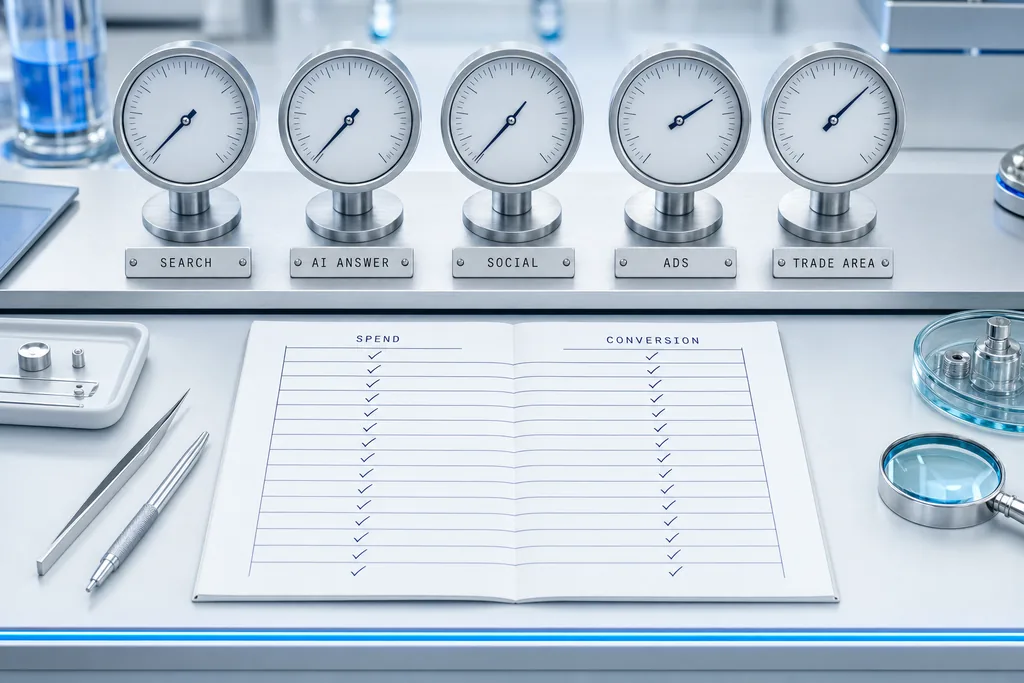
Before anything starts we write down what counts as winning: traffic arriving with no ad behind it, steps taken before someone gets in touch, and what the same revenue cost in marketing. At the close we read all three the same way, seven repeats per question, and set the columns side by side. We fix how we judge, not how big the number gets.
Showing the most recent measurement.
Measurement time, model version, settings hash (provenance — the record of where this value came from and how) stays with every round, and every figure we publish goes into the evidence ledger. What the measurement words mean is fixed on the definitions page, one page. We do not use comparatives without a stated scope. Checked 2026-07-28, scope limited to public pages.
Of the 698 improvement methods on the instrument above, 404 are checked one by one by a validator against the rendered page on every deploy. That is the number you can open the page and verify from outside. The remaining 294 check something else: whether the tool that measures the technique is standing on our side.
Industry measurement cases (self-built proof). Anonymized industry measurements, every one registered in the public claim registry. We do not use comparatives without a stated scope. Checked 2026-07-28, scope limited to public pages. The report comes with a completeness manifest that separates planned, observed, failed, and undecidable.
Data protection — CiteAngle seals measurement calls and region selection with sha256 receipts. Free raw data is deleted after ninety days. Paid measurement raw data, reports, and change receipts transfer to the client within the contract scope.
Convergence gauge — the same question seven times, error under the stability line
You can check our numbers yourself before you buy. Measurement time, model version, settings hash (provenance — the record of where this value came from and how) stays with every round, and every published figure goes into the evidence ledger. Why we re-ask seven times and how the denominator is calculated are both open. Open the measurement method → Figures and evidence ledger
Our instruments are not the only reading. The AI Assistants and Organic channels in GA4, and impressions and clicks in Search Console, are values that live in your own account, so you can set them next to what we measured. How we settled on the re-ask count is in the Methodology — why we re-ask seven times, with the arithmetic.
The measurement method is in the methodology, the basis for outbound copy is in the public claim registry, and the pre-contract verification steps are in the buyer verification guide. All of it open as it is.
That leaves the price.

AI answers are already deciding who gets found. We measure where your brand stands, fix the pages, and run the campaigns. An auditable baseline you can check line by line: the whole grid run, repeated passes, 95% confidence intervals and hash-sealed receipts. One fixed USD quote. Delivered in days — every number checkable by you, against the receipt. Each statement behind our copy sits on a public claims registry with its source type and its date. The counters above are counted again from that list each time this page loads.
The AI engines we put your questions to: ChatGPT, Perplexity, Claude, Grok and Google AI Mode.
Reports, written analysis and Q&A ship without a live meeting. Compare audits and programs →
5
sealed runs, bound to those statements by run identifier
Start an execution program within 30 days of payment and the diagnostic fee is deducted in full. After payment it usually reaches you in two to four business days. From the start of measurement it is one to three business days, and the first day sets the question list. Quotes and contract replies go out one business day after you write.
An annual contract is 10 months of fee for twelve months of service. Two of the twelve you would pay monthly drop out. That is arithmetic, not a gift. Either way, what arrives each month is fixed in the contract.
| Product | Questions asked | Price |
|---|---|---|
| Radar | 5 questions | $399 |
| Compass | 20 questions | $1,199 |
| Panorama | 50 questions | $2,599 |
Get the decision map — Panorama $2,599
Start an execution program within 30 days and the audit fee comes off your first invoice in full.
Work out your net costLast, the questions we are asked most.
Spec and measurement are separate lines here, and we print both. The spec above is what a paid US audit buys. The contract spec for each paid audit is the same shape at every tier: every question on that tier’s panel asked seven times across 21 engine captures, reported across 20 surfaces with a status on every cell. The US reading we have sealed on our own brand is dated July 27, 2026 — 50 questions across 15 answer surfaces, one pass. The seven-run version of that read is the next one scheduled on the US side.
One run is a point estimate, not a number — AI answers vary run to run. That is why each paid audit asks a query seven times and prints the range next to each rate it can. The full case and the math behind the ranges are public in the method.
Japan runs on the same spec. 19 places, every question asked 7 separate times, because a Japanese answer moves the same way an American one does. Where we read: ChatGPT, Perplexity, Claude, Grok, Gemini, Google AI Mode, Google Search, Google AI Overviews, Google News, YouTube, Google short-form video, Bing Search, Bing Copilot, DuckDuckGo search assist, Bing News, Meta AI model answers, X search, Yahoo! JAPAN Search and the Yahoo! JAPAN AI answer — a Japan-only roster, distinct from the US panel above. Spec and measurement stay on separate lines in Japan too. The Japanese reading we have sealed on our own brand is dated July 17, 2026, on a roster narrower than the spec above, so every Japanese figure we quote carries its measurement date and its scope. StatCounter put Yahoo! JAPAN at 6.23% of Japanese search in June 2026. That is a door your Japanese buyers open, and we go in through it with the listing and press work below. The pass mark for the Japanese round is registered before the run, so the line a rate has to clear is set before anyone reads a number. What comes back to you is a ranked list of moves for the Japanese plain-search side, built on those observations.
Press work runs on the same footing. We write the release in Japanese from the start, not as a translation of your English one. It goes out through a Japanese distribution network to Japanese outlets. Each outlet decides what it runs, and a release that gets picked up stays online as Japanese source material that search results and AI answers can both draw on.
One run is one reading
CiteAngle asks one question many times for a single reason. The same question gets a different answer on each run. Academic work calls a single run an unreliable measurement (arXiv), and practitioner guidance says to attach a confidence interval to a re-asked value (Search Engine Land). Both are already public. Profound, a global AI visibility tool, published its own experiment on its blog: re-asking a question ten times cut the daily noise in citation share by about forty percent (original, 2026-07-08).
How many questions we ask, mostly. Radar ($399) asks five branded queries and settles one thing: do the engines know your brand at all. Compass ($1,199) widens to twenty questions across the same 20 places, measured by machine, with a person checking the package before we send it. Panorama ($2,599) runs all fifty across the same 20 places and adds the async commentary layer. That means a written read built from your run, the 15-slide executive brief and email Q&A.
Delivery is fully async. The report arrives on your dashboard — the 15-slide executive brief on Panorama, monthly written decision memos and recorded briefings on programs. Email Q&A comes with a two-business-day reply, on your schedule, in any time zone. Briefings, decision meetings and board talks run the same way. No meeting is needed to make the call.
Reports, written analysis and Q&A ship without a live meeting. Compare audits and programs →
The read runs by itself
Dashboard report
A written read built from your run
Brief for the board
Email Q&A
ARTIFEX Co., Ltd. is the Seoul-headquartered Korean corporation that operates CiteAngle. Registration details and the measurement lead are on the company page.
| Item | Detail |
|---|---|
| Operator | ARTIFEX Co., Ltd. — Seoul-headquartered Korean corporation |
| Hub | artiaudit.com |
| Company page | Registration, representative, contact |
20places your name can appear all of them read on every paid audit — 7,350 planned observations
A paid audit runs the whole plan — each question, each run, each place. It reports every planned observation with its status: observed, cited, failed, or indeterminate, which means too vague to call. You see the whole thing, and no observation quietly leaves the count.
7
runs per question — AI answers move, so we catch the swing instead of trusting one reply
Standard on each paid audit
20
places an answer can show up — the full US panel, named in the method
Full set on each audit tier · method in the open
50
buyer questions in a full Panorama, every answer kept with its own status — Compass asks 20, Radar 5
Wilson score 95% confidence intervals on the citation rates we can compute · rules published in the method
The US answer layer, measured surface by surface — 20 major AI and search surfaces, one grid. A surface is one place a buyer reads an answer; an engine is the service that writes it, and one engine can fill two surfaces. One pass is a story, not a read. AI answers move day to day, so each paid audit puts every buyer question to every place on this list 7 separate times and keeps all 7 replies. The swing then becomes a number. Where we read: ChatGPT, Perplexity, Claude, Grok, Gemini, Google AI Mode, Google Search, Google AI Overviews, Google News, YouTube, Google short-form video, Bing Search, Bing Copilot, Yahoo Search, DuckDuckGo search assist, DuckDuckGo organic, Bing News, Meta AI model answers, Google Shopping, and X search.
AI Overviews and AI Mode cite different sources. They are two Google surfaces, not two windows onto one, and the same question can pull a different set of pages into each. So both keep their own line on the list above: work that puts you in one does not carry over to the other on its own, and we report them apart and write the moves for each.
Spec and measurement are separate lines here, and we print both. The spec above is what a paid US audit buys. The contract spec for each paid audit is the same shape at every tier: every question on that tier’s panel asked seven times across 21 engine captures, reported across 20 surfaces with a status on every cell. The US reading we have sealed on our own brand is dated July 27, 2026 — 50 questions across 15 answer surfaces, one pass. The seven-run version of that read is the next one scheduled on the US side.
One run is a point estimate, not a number — AI answers vary run to run. That is why each paid audit asks a query seven times and prints the range next to each rate it can. The full case and the math behind the ranges are public in the method.
Japan runs on the same spec. 19 places, every question asked 7 separate times, because a Japanese answer moves the same way an American one does. Where we read: ChatGPT, Perplexity, Claude, Grok, Gemini, Google AI Mode, Google Search, Google AI Overviews, Google News, YouTube, Google short-form video, Bing Search, Bing Copilot, DuckDuckGo search assist, Bing News, Meta AI model answers, X search, Yahoo! JAPAN Search and the Yahoo! JAPAN AI answer — a Japan-only roster, distinct from the US panel above. Spec and measurement stay on separate lines in Japan too. The Japanese reading we have sealed on our own brand is dated July 17, 2026, on a roster narrower than the spec above, so every Japanese figure we quote carries its measurement date and its scope. StatCounter put Yahoo! JAPAN at 6.23% of Japanese search in June 2026. That is a door your Japanese buyers open, and we go in through it with the listing and press work below. The pass mark for the Japanese round is registered before the run, so the line a rate has to clear is set before anyone reads a number. What comes back to you is a ranked list of moves for the Japanese plain-search side, built on those observations.
We also do the Japanese-side work the reading points at. If you run stores or facilities in Japan, we take the listing work. Yahoo! JAPAN gives owners a free tool for filing facility details, and we do that filing and keep the entry current. What people see on Yahoo! JAPAN Search and Yahoo! JAPAN Maps stays accurate. The same tool counts how often the listing was shown, and it counts the taps on your website, phone number, directions and booking button. It also separates the people who searched your name from the people who found you another way. Those counts pick the next thing we fix.
Press work runs on the same footing. We write the release in Japanese from the start, not as a translation of your English one. It goes out through a Japanese distribution network to Japanese outlets. Each outlet decides what it runs, and a release that gets picked up stays online as Japanese source material that search results and AI answers can both draw on.
Every buyer query ends in one of four states. You rank and the answer carries you. You rank and it names someone else. You are missing from both. Or the answer found you with no plain-search rank at all. Each state calls for a different move, and your own distribution comes from your run.
The four states, on two axes
Send us a brand name and an email address. We confirm which screens put you in front and which ones put another name there. That comes back as a proposal, with the diagnostic report attached.
Run the free check now FreeDiagnostic report includedUp to 30 percent off
ARTIFEX Co., Ltd. · support@citeangle.com
CiteAngle is the US web-visibility practice of ARTIFEX Co., Ltd.. ARTIFEX Co., Ltd. is the Seoul-headquartered Korean corporation that operates CiteAngle. We read where a brand gets found across search and AI answers, and we run the work that moves it.
Get your free AI visibility checkGoogle lets you choose preferred sources — the sites you want to see more often in your own results. If our work is useful to you, add citeangle.com there. You can remove it again at any time, and the setting lives in your Google account, not ours.
Set CiteAngle as a preferred sourceLegal and security reviewers ask the same four questions before they sign. Here are the answers, in the words our contract documents use.
Training data
No. CiteAngle switches on the training and storage opt-outs each AI provider offers. The queries we send carry no personal contact details. The privacy policy names every provider, what it receives, and how long it keeps it.
Client data
Into your report and the work of checking it. CiteAngle holds each client’s material apart, inside the scope and the time limit the contract sets. A Search Console link is read-only and reaches only the properties you pick. Cut it from the same screen whenever you want. Figures we publish never name a client.
Security controls
Storage and processing sit in the Seoul region. We encrypt everything in transit. Every record type has a published retention clock: 30 days for a copy of an email we sent, 90 days for raw free-check measurement, up to 5 years for paid audit evidence, and account details until you close the account. Deletion runs from your account settings, by email, or through a connected Facebook or Instagram account. We publish the security contact in the standard machine-readable place. Report a flaw and you get an acknowledgement first, then the fix in the same thread.
Cost structure
USD list prices sit on the site. You can read every audit and program price without contacting us. Prices shown exclude applicable sales tax. What you pay for the audit comes off the program that follows. The quote fixes the final amount, and we bill nothing outside it.
All four link back to the source documents.
Open the trust center: terms, retention clocks from 30 days to 5 years, and how we check the numbers
Ready to turn US visibility evidence into a market plan? Tell us the US buyer, target state and decision date.
Request a written proposal